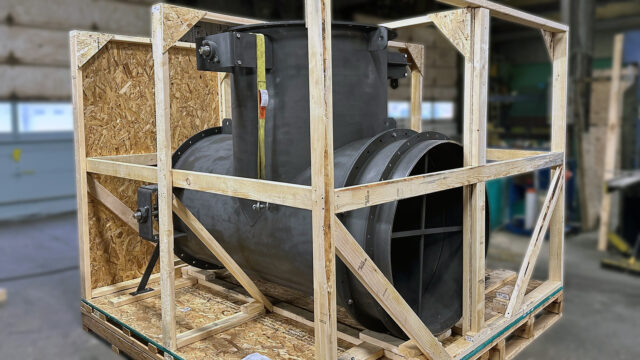
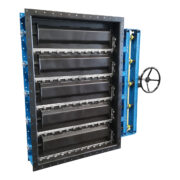
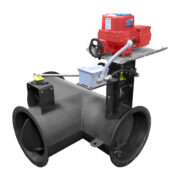
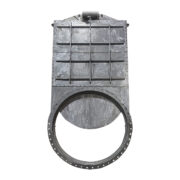
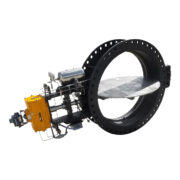
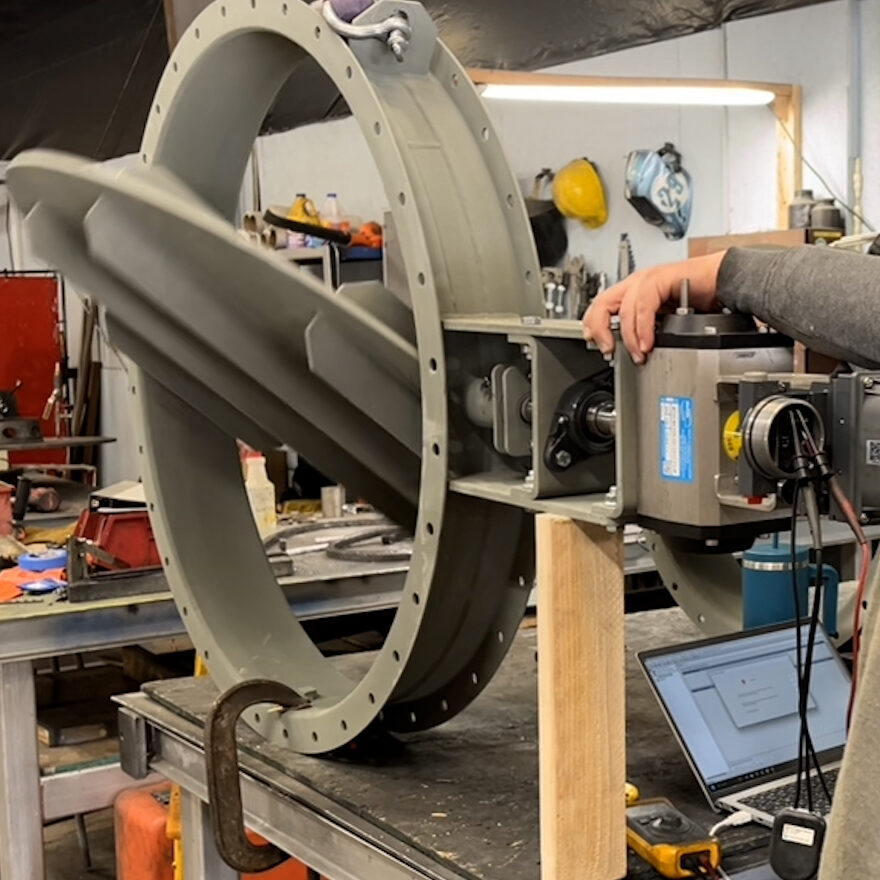
When a damper arrives on-site, there’s no room for uncertainty. It needs to perform on command, respond correctly to signals, and—if power is lost—move to its fail position without hesitation. That’s why every unit leaving Elite Industrial Controls undergoes rigorous damper actuation testing and programming.
This blog covers the full process: from basic functionality checks to advanced DVC programming for modulating actuation.
Damper Actuation Testing: Reliability Before Installation
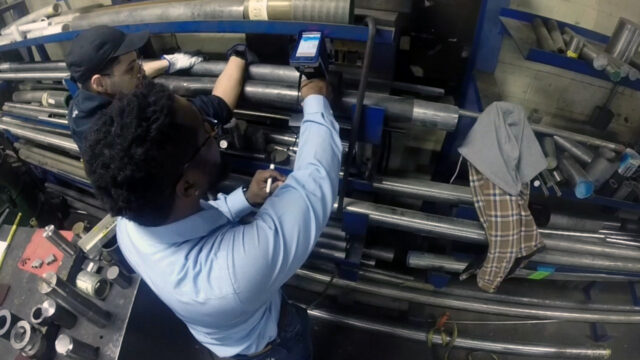
Before leaving our shop, each damper is put through final actuation testing to verify:
-
The actuator is receiving the correct signal
-
The damper responds as expected
-
Fail position testing confirms proper function in a power-loss scenario
This testing eliminates surprises in the field and ensures smooth, reliable installation.
Advanced Actuation Testing: DVC Programming for Modulating Dampers
For projects requiring precision control, we integrate Digital Valve Controller (DVC) programming. This step allows for fine-tuned actuation, beyond simple open/close commands.
Key Capabilities:
-
Fully Automated Solutions: Valves and dampers with optional self-diagnostics for real-time performance monitoring.
-
Expertise in Automation: Our Final Controls team programs pneumatic, electric, hydraulic, and manual actuators.
-
Customization & Testing:
✔ Calibration beyond fixed increments to match system requirements
✔ Operation test reports & Factory Acceptance Testing (FAT) available
This level of programming ensures every damper isn’t just functional—it’s optimized for your specific system after completing our actuation testing process.
Why It Matters
Combining actuation testing with advanced programming delivers:
-
Quality: Equipment proven under real-world conditions
-
Reliability: Predictable performance in critical scenarios
-
Ease of Installation: Contractors can connect and go—without field recalibration
-
Smart Monitoring: Self-diagnostics for proactive maintenance
At Elite Industrial Controls, testing doesn’t stop at verifying basic function. With damper reliability testing, calibration, and FAT, every damper we ship is field-ready, reliable, and customized to your system’s needs.
Damper Actuation Testing FAQ’s
What is damper actuation testing?
– It’s the process of verifying that a damper’s actuator responds correctly to control signals and moves to the proper fail position during a power loss.
What is DVC programming?
– Digital Valve Controller (DVC) programming fine-tunes actuator response for precise, modulating control and allows self-diagnostic monitoring.
Why is actuation testing important?
– It prevents costly installation delays and ensures reliable, field-ready performance.